Multi-Point Inspection Checklist for Dealership Service Departments
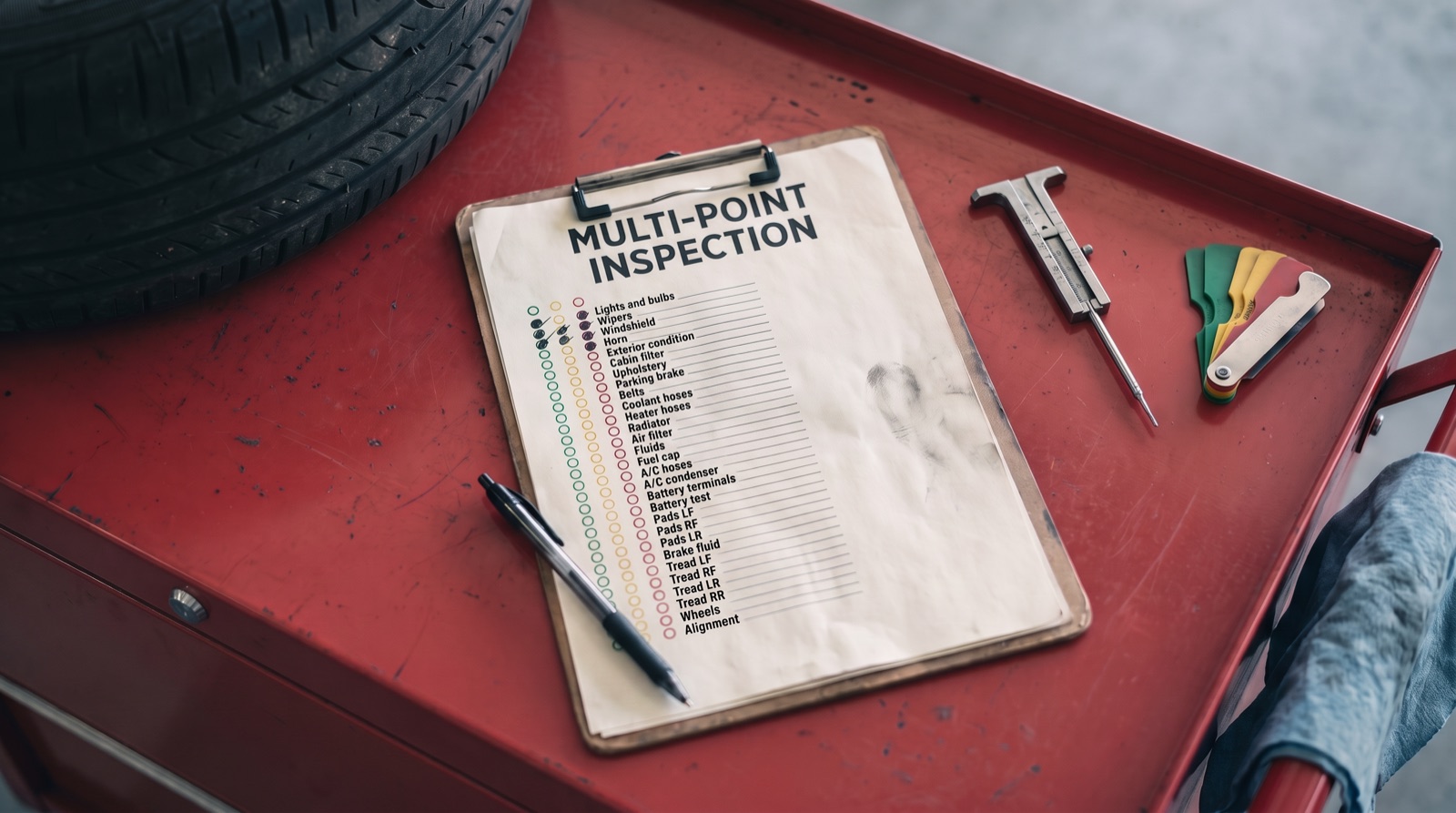
Pull 20 MPIs from last week. Count how many are all green with one tire reading filled in. That is a checklist getting done, not a vehicle getting inspected.
The fix is not a longer form. It is a checklist built in the order the tech actually walks the car, with numbers where numbers exist and a clear line between yellow and red.
TL;DR: A dealership multi-point inspection checklist should cover about 38 items in the order the tech walks the car: exterior, interior, under the hood, battery, brakes, tires, then undercarriage on the lift. Measure pads, tread and battery against set red and yellow lines, and write a note on every item that is not green.
What is a multi-point inspection checklist?
A multi-point inspection (MPI) is the condition check a technician runs on every vehicle that comes through the service drive, whatever it came in for. The checklist is the list of items checked, each marked green (good), yellow (needs attention soon) or red (needs attention now). The advisor turns the yellows and reds into recommendations, and the customer gets a report on their vehicle’s health.
In a franchise dealership, the MPI has one more job. A red item on a car still under factory coverage is a warranty line, not a customer-pay sale, and the advisor needs to know which is which before calling the customer.
The 38-point MPI checklist, in walk order
This is the 38-item list TenthGear’s voice-first MPI uses, grouped in the order a tech moves around the car. Same order on every car is what keeps items from getting skipped. Skip what the vehicle does not have: no belts, exhaust or fuel system on an EV, no clutch on an automatic.
Exterior
5 points
- Lights and bulbsHeadlights, taillights, brake lights, turn signals
- Wipers and washer sprayBlades, arms, washer fluid spray
- Windshield and windowsChips, cracks, seals
- HornWorks, sounds right
- Exterior conditionBody panels, paint, bumpers, trim
Interior
3 points
- Cabin filterCondition, if equipped
- Upholstery, carpet, mats, mirrors, trimDamage, wear, anything loose
- Parking brakeEngages and holds
Under the hood
9 points
- Belts and tensionersCracks, glazing, tensioner wear
- Cooling system hosesSwelling, cracks, seepage at connections
- Heater hosesSame, on the hoses to the heater core
- Radiator coreBent fins, debris, leaks
- Engine air filterDirt load
- FluidsOil, coolant, power steering and washer levels and condition
- Fuel cap gasketSeal intact
- A/C hoses and connectionsOily residue at fittings
- A/C condenserDamage, debris, leaks
Battery
2 points
- Terminals, cables, mountingCorrosion, loose clamps, hold-down
- HealthTest result (see the lines below)
Brakes
5 points
- Pads: LF, RF, LR, RRThickness in mm, each wheel
- Brake fluidLevel and condition
Tires and wheels
6 points
- Tread: LF, RF, LR, RRDepth in 32nds, each tire
- WheelsCurb rash, bends, cracks, corrosion
- AlignmentUneven wear, pull
Undercarriage, on the lift
8 points
- ExhaustMuffler, pipes, converter, hangers
- Fuel systemLines, tank, tank straps, vapor hoses
- LeaksOil or fluid from any source
- Transmission, differential, transfer caseLeaks, damage
- ClutchManual transmissions only
- Shocks and suspensionLeaking struts, worn bushings
- SteeringGear, linkage, boots, ball joints
- DrivelineCV boots, U-joints, drive shaft
Swipe or scroll for all seven stops →
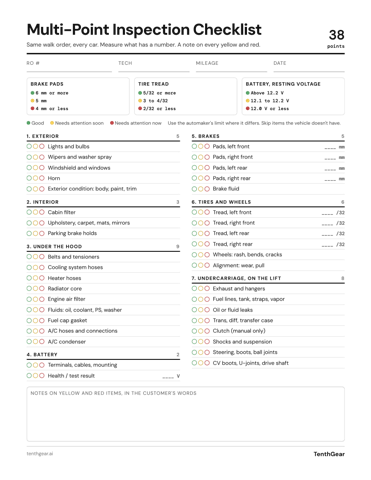
Free download: the printable MPI checklist
All 38 points on one page, US Letter, with the red and yellow lines and a notes box. No signup.
Download PDFRed, yellow, green: where do you draw the lines?
A checkmark is an opinion. A number is a finding. Three items on every car can be measured, so measure them every time and flag them against the same lines.
Brake pads
- 6 mm or more
- 5 mm
- 4 mm or less
Tire tread
- 5/32" or more
- 3 to 4/32"
- 2/32" or less
Battery, resting voltage
- Above 12.2 V
- 12.1 to 12.2 V
- 12.0 V or less
These are the defaults TenthGear ships with. Where the automaker publishes a different service limit, use theirs. The tire red line is not arbitrary: 2/32 inch is the minimum in the federal vehicle-in-use inspection standard. A resting voltage tells you state of charge, not battery health, so if your shop has a battery tester, record its result and flag on its verdict.
Why do techs pencil-whip the MPI?
“Pencil-whipping” is marking the form without doing the inspection. Writing in CBT News, Don Reed said managers “permit ‘pencil whipping’ to complete all the tasks and move the cars forward.” The reasons are not a mystery:
- It is unpaid flat-rate time. At most stores a completed MPI pays the tech nothing. The paid job is waiting.
- The form is a second job. The tech inspects the car, then walks to a terminal and types it all in.
- Nobody uses it. If the advisor never presents the yellows, the tech stops finding them.
We put numbers on what that costs in why your MPI completion rate is your biggest revenue leak.
How to make the checklist actually get done
- Same walk order on every car. Exterior to undercarriage, every time. Habit beats memory.
- Three numbers on every car. Pads, tread, battery. No reading, no MPI.
- A note on every yellow and red. What you saw, in words the customer will understand. “Front pads are at 3 mm, replace them now to save the rotors” sells. “LF pad low” does not.
- Show the reds. Dealers who self-report as both more efficient and more profitable were more likely to have built photos or videos into their MPIs, 47% versus 34% of other dealers, in the Cox Automotive 2026 Fixed Ops and Ownership Study. Our MPI video shot list covers what to say and show.
- The advisor presents every yellow and red, and logs every decline. Declined yellows are next visit’s work. Here is how to follow up on declined service.
Take the typing out of it
Most of the cost of a good MPI is the second job: typing up what the tech already saw. With TenthGear, the tech says it instead. “Left front pad, 3 millimeters” fills in the item with the measurement and the right color, on a color-coded carousel that follows the same 38 items above. If the tech shoots an MPI video, TenthGear matches what they said on camera to the checklist, and the tech reviews the findings before anything is applied. The customer gets a report with the reds and yellows in plain language.
Run it for one week
Print the checklist, give it to three techs, and compare their MPIs to last week’s. Count the measurements, the notes and the yellows the advisors presented. The gap is your opportunity.
Want to see a voice MPI fill itself in? Book a demo and we will show you on a real RO.