Warranty Parts Markup Increase: How Dealers Calculate and File
Short answer
To file for a warranty parts markup increase, confirm your state's rules, pull the required sample of qualifying customer-pay repair orders, and calculate your markup using the method your statute applies. One common method is (total eligible parts charges ÷ total eligible parts cost − 1) × 100. For example, $18,000 in charges on $10,000 in cost is an 80% markup.
Here is what that can be worth. The calculator starts with an illustrative example of $20,000 a month in warranty parts at cost, moving from 40% to 80% over cost. Swap in your own numbers.
Calculator
What is a parts markup increase worth?
Add zero-cost exchange parts
Parts the OEM ships at no charge, where you may be paid only a handling allowance. Starts with the Montana radio example covered below.
Illustrative math, not a benchmark or legal advice. The zero-cost estimate uses the method in states such as Montana and Minnesota: your markup times the part's wholesale value. Your state's method may differ. Numbers stay in your browser.
This number is separate from your labor rate. If you are filing for both, our warranty labor rate reimbursement guide covers the labor side.
How do you calculate warranty parts markup?
Divide total eligible parts charges by total eligible parts cost, subtract 1, and multiply by 100, unless your statute says otherwise. Minnesota, California and Ohio all spell out this method.
Using the example above, $18,000 ÷ $10,000 = 1.8. Subtract 1 and multiply by 100 to get 80%.
Is parts markup the same as parts margin?
No. Markup is profit as a percentage of cost. Gross margin is profit as a percentage of the sale. Your parts manager may quote margin, so convert before you compare it with a markup filing.
| Cost | Sold for | Markup | Gross margin |
|---|---|---|---|
| $100 | $140 | 40% | 28.6% |
| $100 | $160 | 60% | 37.5% |
| $100 | $180 | 80% | 44.4% |
Why does the averaging method matter?
The same ROs can produce very different results under different methods. Take a $10 part sold for $20 (100% markup) and a $1,000 part sold for $1,400 (40% markup). Total charges over total cost gives 40.6%, because the expensive part carries more weight. A simple average of the two percentages gives 70%.
Florida is an exception to the formula above. If you and the manufacturer do not reach agreement within 30 days of your written request, parts compensation is the greatest of three things: your arithmetical mean percentage markup on the sample, the manufacturer’s highest suggested retail or list price, or a markup based on your parts gross profit percentage from your financial statements.
What repair orders go in the sample?
A common sample is 100 sequential customer-pay ROs or 90 days of ROs, whichever is less, from the last 180 days. Minnesota, Illinois, Nebraska and Tennessee all use a version of it. Florida uses 50 consecutive retail repairs from the three months before your request. It also requires 10 days’ written notice, and the manufacturer can pick the starting RO in that window.
Then remove only what your statute excludes. Minnesota excludes promotional repairs, wholesale parts, routine maintenance, fasteners without a part number, tires, reconditioning and accessories.
Big-ticket assemblies are where states split. Florida excludes engine and transmission assemblies. Minnesota excludes them only if the dealer agrees to a handling charge instead of a markup.
Expect to go through a lot of ROs. Frank O’Brien wrote in a 2018 F&I article that reaching 100 qualifying ROs could take more than 1,000 actual ones, and California requires you to include the nonqualified ROs from the same period.
Can a parts markup filing lower your rate?
Yes. In Beck Chevrolet v. General Motors, a New York dealer went from 73% to 62.30% after two qualifying transmission repairs were included.
The dealer had declared 81.62%. GM found the two repairs had been left out, added them back and cut the rate. New York’s DMV Appeals Board upheld GM in October 2019. This account comes from an article by GM’s counsel in the case, so it is one side’s summary, under one state’s law.
Note: the dealer also proposed averaging the markup per RO, which produced 85.18%. That method lost too.
Before you submit, have a second reviewer check every skipped RO and every excluded parts line against the statute.
Free worksheet
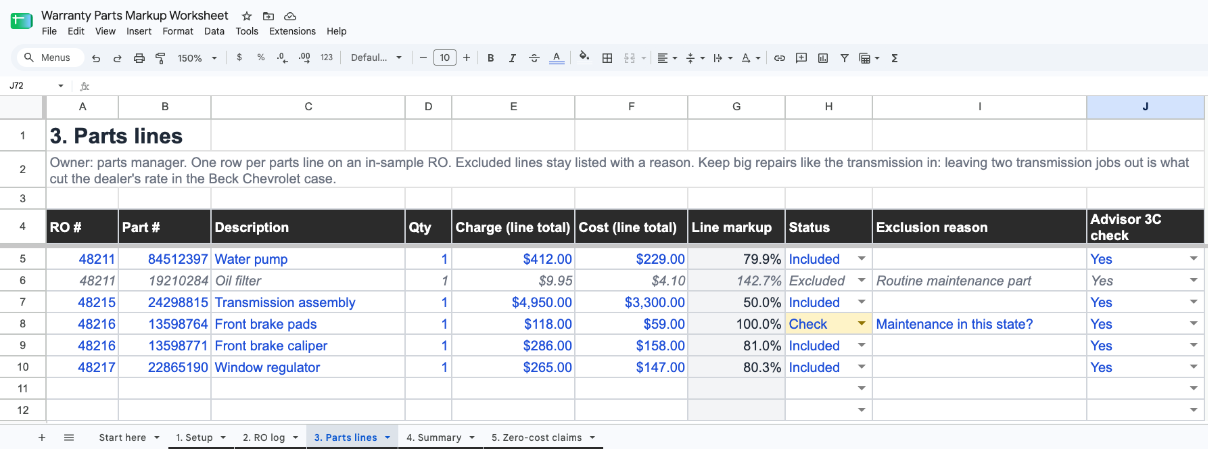
Warranty Parts Markup Worksheet
Five tabs, one per role: state setup, the RO log with skip reasons, parts lines with exclusion reasons and the advisor check, a summary that runs the markup two ways with a second-reviewer sign-off, and a zero-cost claims log. Works in Google Sheets or Excel.
What are the warranty parts markup rules by state?
They vary on how often you can file, how long the manufacturer has to respond, and when the rate starts. These six show the range. All were checked on November 8, 2026. Laws change, so confirm yours with your state dealer association or counsel before you file.
Swipe the table to see all four columns.
| State and statute | Parts filings allowed | OEM response or contest deadline | When the rate takes effect |
|---|---|---|---|
| California, Veh. Code §3065.2 | Once per calendar year | Contest within 30 days of your notice, or of receiving requested supplemental ROs | Day 30 after the OEM receives notice. If contested, the OEM’s proposed rate applies until the dispute is resolved |
| Florida, Stat. §320.696 | No more than semiannually | Statutory formula applies if no agreement within 30 days of your request | Increases apply to claims filed 15 days after the OEM receives your request |
| Illinois, 815 ILCS 710/6 | Twice per calendar year | Audit within 30 days of your declaration | 30 days after your declaration, subject to audit adjustment |
| Minnesota, Stat. §80E.041 | Once per year | Written disapproval within 30 days, or the rate is approved | No date stated in this section |
| Nebraska, Rev. Stat. §60-1438 | Twice per calendar year | Audit and approve or deny within 30 days of receiving the ROs | 45 days after approval |
| Tennessee, Code §55-17-121 | Once in any one-year period | Approve or deny within 30 days of your submission and any requested documentation | 45 days after approval |
Some states, including California and Ohio, also let you use one RO set for labor and parts or file separate sets. Look up warranty parts markup by state here.
Are you getting paid on zero-cost parts?
Pull a few recent OEM-supplied exchange claims and compare what the OEM paid with the reimbursement method in your state. A handling allowance may be less than your statute calls for.
The rules differ. Minnesota, Nebraska, Montana and California tie payment to your markup and a defined wholesale value of the part. Florida uses its parts compensation method, less the dealer cost in the price schedule. Illinois pays your markup on most supplied parts, but caps entire engine, transmission and electric vehicle battery assemblies at up to 30% of what you would have paid for the assembly.
The calculator above starts with this Montana example, from a 2024 article by Jordan Jankowski of warranty-recovery firm Armatus: $995 × 80% = $796, or $771 above the $25 handling allowance in that example.
Armatus sells this service, so test it against your own statute. Jankowski says many manufacturers make dealers ask for this payment, and he advises checking how the claim is characterized so it does not affect your warranty expense report.
Who does what before you file?
Hand the work off by role. The worksheet above has a tab for each of these roles.
Fixed ops director
- Confirm the current OEM markup in writing.
- Size the opportunity with your own warranty parts cost.
- Own the filing calendar: earliest filing date, OEM response deadline and effective date.
Service and parts managers
- Pull the RO sequence your statute requires, without hand-picking.
- Reconcile parts charges and parts costs against the ROs.
- Document skipped ROs separately from excluded parts lines, with the reason for each.
Service advisor
- Before closeout, check that the customer concern, technician finding and repair performed line up with the parts on the RO.
Where TenthGear fits
TenthGear does not file your submission or set your markup. Techs talk through the work, and TenthGear captures the complaint, cause and correction and grades the story. That gives advisors and managers a clear repair story to review and fix before closeout. For more on what makes a story weak, see our guide to reducing warranty claim denials.